
IDSN brought together #DalitVoicesForJustice, UN experts, civil society and Member States for our HRC62 side-event, Caste, Gender and Power: #DalitVoicesForJustice on 2 July at the UN Human Rights Council.
The event highlighted the urgent need to explicitly address caste and gender discrimination as a root cause of widespread human rights violations across South Asia. This was underscored by powerful addresses from the UN Special Rapporteur on Racism, Dr. Ashwini K.P. and the UN Special Rapporteur on Minority Issues, Prof. Nicolas Levrat.
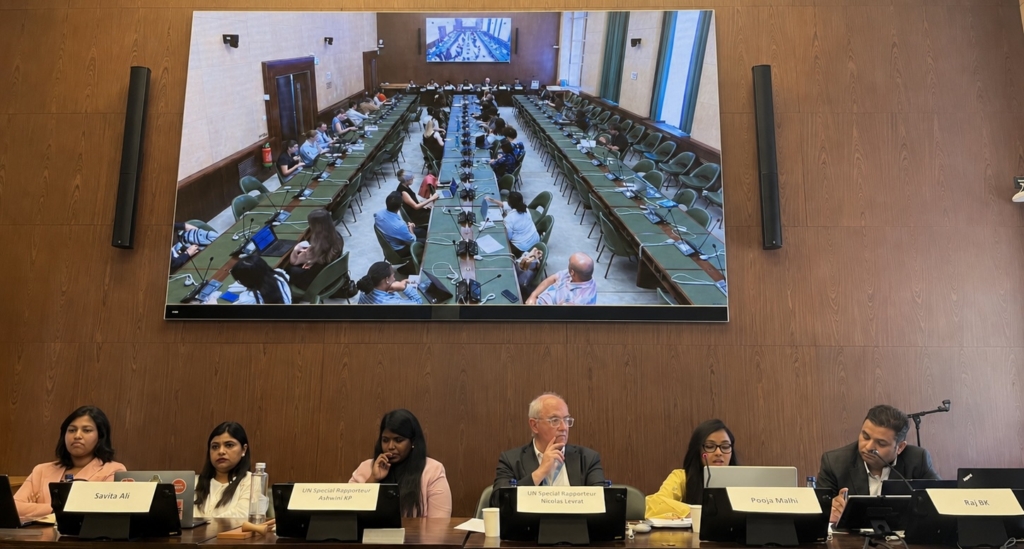
Ashwini K.P., underlined that caste-based discrimination must be explicitly recognised as a serious global issue, noting the distinct ways in which caste operates, including untouchability, caste-based sexual violence and the compounding impact of caste, gender, disability, religion and sexual orientation. She stressed that Dalit women are not only among those most affected, but are also human rights defenders, movement leaders and experts and called on the UN and other anti-racism mechanisms to explicitly acknowledge caste and support Dalit women’s meaningful participation in justice, political representation and decision-making beyond symbolic inclusion.
Nicolas Levrat, reflected on his work on Nepal and on caste as a specific minority issue, highlighting caste-based violence linked to inter-caste marriage, low prosecution rates and the limits of legal protections and quotas when they are not meaningfully implemented. He stressed that caste-based hierarchies affect at least 250 million Dalits in South Asia, alongside analogous forms of occupational discrimination elsewhere, and that such entrenched systems are incompatible with the basic human rights principle that all human beings are born free and equal in dignity and rights.
Speaking from India, Sri Lanka, Pakistan, Bangladesh and Nepal, IDSN’s delegation shared powerful testimony on how caste-based discrimination intersects with gender, religion, class and work and descent, shaping access to justice, education, political participation and access to decent work as services.
Savita Ali, from Eva Foundation, India, gave a stark account of the continued prevalence of untouchability and caste and gender discrimination, and how these intersect with patriarchy, religious discrimination and institutional impunity. She highlighted the targeting of Dalit women and girls, including killings linked to accusations of witchcraft, rape, custodial violence, mob lynching, honour killings, hate crimes and hate speech. She also drew attention to discrimination and violence faced by Pasmanda Muslims, Dalits who have converted to Islam and other religious minorities. Drawing on her legal and grassroots work, Savita underlined how Dalit survivors and human rights defenders continue to face false counter-cases, intimidation and pressure to withdraw complaints. She called on India to establish an independent national mechanism to monitor caste-based atrocities and investigate institutional failures, urged stronger gender-sensitive police accountability and called on the UN to encourage India’s meaningful engagement with the upcoming CERD review.
Dharsika Sivapragasam, from the Human Development Organisation, Sri Lanka, highlighted the situation of Malaiyaga Tamil plantation worker women, who experience caste discrimination and entrenched inequalities in political participation, healthcare, labour rights and access to public services. She noted that, despite generations of contribution to Sri Lanka’s economy through tea, rubber and coffee plantations, the Malaiyaga Tamil community continues to face poverty, landlessness, inadequate housing, wage inequality, workplace harassment and gender-based violence, limited access to leadership and low representation in trade unions and local decision-making. She called for stronger minority rights mechanisms and monitoring measures to ensure their meaningful political participation.
Pooja Malhi, from Pakistan Dalit Solidarity Network, drew attention to Dalit and other religious minority communities in Pakistan as “minorities within minorities”, facing intersecting discrimination based on religion, caste and socio-economic status. She highlighted barriers to education, decent work, healthcare and justice, as well as discrimination, bullying and social exclusion of Dalit children in schools.
Pooja also addressed child labour, bonded labour, landlessness and hazardous work affecting Dalit and other marginalised caste communities, particularly in agriculture, brick kilns, sanitation and textiles. She stressed the risks faced by minority and Dalit girls, including forced religious conversion, forced marriage, school withdrawal and early marriage. She called on Pakistan to criminalise caste-based discrimination and forced conversion of minor girls, enforce laws against child labour, bonded labour and child marriage and ensure safe and inclusive education.
Raj BK, from Jagaran Media Center, Nepal, spoke about the continued impact of systemic and structural caste-based discrimination in Nepal, despite legal abolition of the caste system and constitutional protections against untouchability and discrimination. He highlighted how Dalits continue to face social exclusion, violence and severe underrepresentation in state decision-making structures.
Raj focused on Dalit political participation, noting that constitutional and electoral provisions have enabled important representation of Dalit women at local level, but entrenched caste-based power structures still limit their influence. He underlined that Dalit parliamentary representation remains far below population share, with Madhesi Dalits still excluded from representation. He called on Nepal to ensure proportional Dalit participation in Parliament, enforce laws countering caste-based discrimination with strict accountability and fully implement constitutional provisions on the fundamental rights of Dalits.
Two other IDSN delegation members spoke from the floor. Provati Das of DALIT, Bangladesh, highlighted the intersecting caste- and gender-based discrimination faced by Dalit women and girls in Bangladesh, including high levels of child marriage, barriers to education, and exclusion from leadership and decision-making, and called for stronger government and international action to uphold their rights, dignity and inclusion. Chandrashekar R. V. of Thamate, India, stressed that despite constitutional guarantees and legal bans, caste discrimination continues to force many Dalits into dangerous and degrading work, including manual scavenging and sewer and septic tank cleaning, and urged India to fully enforce its laws, ensure rehabilitation and compensation and promote dignity, equality and decent work.
Across the delegation, the message was clear: caste and gender discrimination must be addressed explicitly, systematically and with the leadership of affected communities at the centre. States, UN mechanisms and the international community must act on the recommendations of Dalit human rights defenders and ensure accountability, representation and justice.
The side-event was well attended and IDSN thanks all speakers, participants, co-sponsors, and allies who joined us in Geneva to stand with #DalitVoicesForJustice.
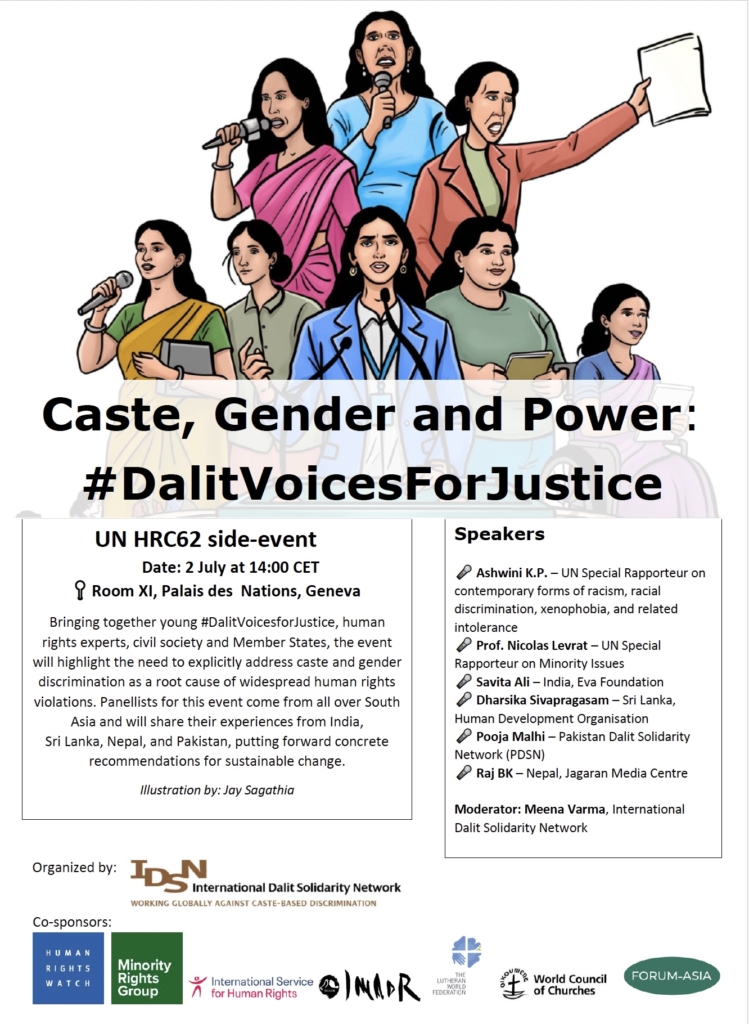
UN HRC62 side-event flyer
Screenshot