
On 14 April 2026, the European Parliament’s Subcommittee on Human Rights held a public hearing on caste discrimination in South Asia, bringing renewed attention to caste as a structural human rights issue and to the need for stronger and more explicit European Union action. The hearing brought together the United Nations, the European External Action Service (EEAS), civil society and testimony from IDSN member, Pakistan Dalit Solidarity Network.
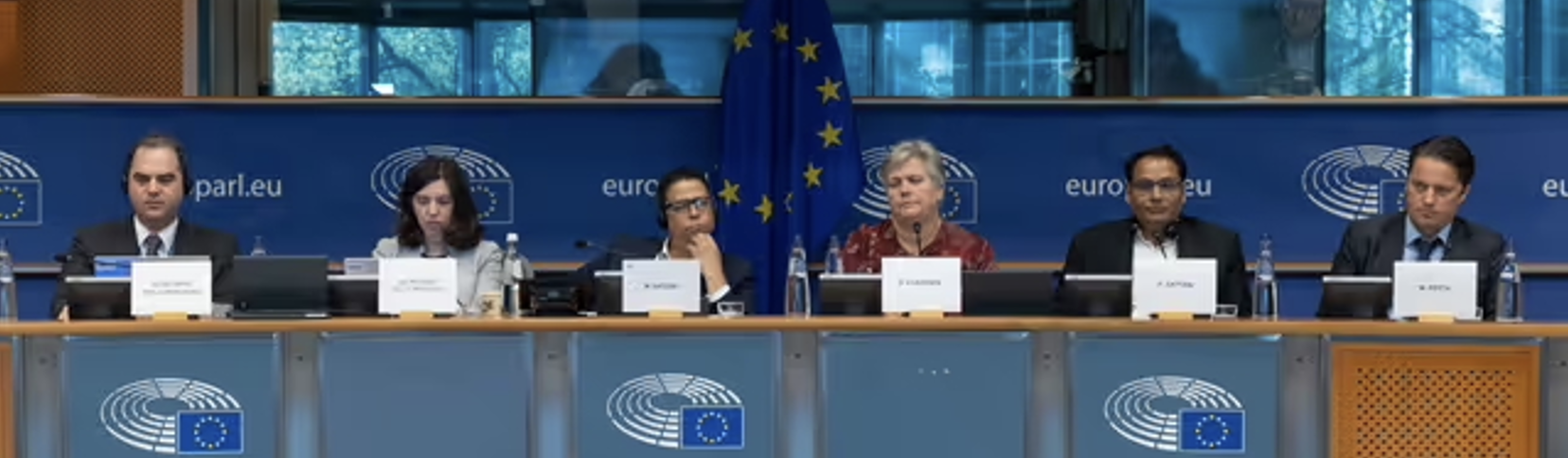
Photographer: Alexis HAULOT Copyright: © European Union 2026 – Source : EP
Chaired by MEP Mounir Satouri, the hearing featured Ashwini K.P., UN Special Rapporteur on contemporary forms of racism, Sandra Claassen, Director of Arisa, Pirbhu Satyani, representing IDSN and Michal Pesta, Acting Head of Division for South Asia, Asia and Pacific Department, EEAS.
Caste discrimination as a structural human rights issue
Speakers underlined that caste discrimination continues to deny millions of people access to justice, education, decent work, public services and dignity. The discussion made clear that caste discrimination must not be dismissed as a cultural issue, but recognised as a deeply entrenched system of exclusion with serious implications for human rights and equality.
Ashwini K.P. emphasised the importance of addressing caste discrimination through an intersectional lens, especially in relation to Dalit women. She stated: “For Dalit women, discrimination is not experienced as two separate issues: Caste on one hand and gender on the other.” She also called for stronger legal recognition of caste, saying: “It is the need of the hour to explicitly and legally recognize caste as a protected ground under all forms of anti-discrimination law in regional and national frameworks, including the international human rights framework.”
Supply chains and corporate responsibility
A key focus of the hearing was the role of caste discrimination in South Asian supply chains linked to European companies. Sandra Claassen warned that caste discrimination remains a major blind spot in business and human rights discussions.
Her intervention highlighted the need for EU human rights due diligence and related implementation measures to explicitly address caste discrimination as a relevant and foreseeable supply chain risk.
Pakistan and the role of the EU
Speaking on behalf of IDSN, Pirbhu Satyani drew attention to the realities faced by Dalits in Pakistan, including bonded labour, child labour, hazardous sanitation work, discrimination in education and forced conversion of girls. He called for concrete legal and policy change, stating: “Pakistan needs to criminalize caste-based discrimination and enforce laws to prevent forced religious conversion and forced marriages.”
From the EEAS, Michal Pesta reaffirmed that non-discrimination and minority rights are core EU values and stressed the universal nature of addressing caste discrimination. He stated: “The principle is not a Western value or European value. It’s a universal one.” He also pointed to EU engagement through political dialogue, civil society exchanges and funding for projects addressing minority discrimination in South Asia.
Next steps
The exchange with Members of the European Parliament present at the hearing including leading members of key sub-committees concerned, showed growing political concern about caste discrimination across South Asia and raised questions about trade conditionality, development cooperation, children’s rights and colonial legacies. In his concluding remarks, Mounir Satouri stressed the importance of integrating caste discrimination more systematically into the work of the European Parliament and raising the issue consistently across EU institutions.
For IDSN, the hearing marked an important opportunity to reinforce that caste discrimination requires explicit and sustained EU action across human rights dialogue, development cooperation, trade monitoring and corporate accountability and human rights due diligence. It also highlighted the importance of ensuring that affected communities remain at the centre of advocacy and policymaking. IDSN calls for a new European Parliament report and resolution to be adopted during 2026 or early 2027 to update the one from 2013 and take into account the new range of EU instruments at its disposal in helping fight caste-based discrimination.
In connection with the hearing Pirbhu Satyani met with EU officials at the European External Action Service and the European Commission’s Directorate General for Employment, working on Pakistan, India, labour rights, minority rights, children’s rights, business and human rights. He discussed the main challenges facing Pakistan in these areas, with a particular focus on the Dalits. He explained the progress that had been made in several areas by the Government, with the added incentive of the EU’s GSP+ scheme, but with the proviso that the full impact of most measures had not reached the most marginalised Dalit populations, especially in rural areas. He discussed the possibilities for the EU’s Special Representative for Human Rights to discuss these with Pakistani diplomats.