
At the Eighteenth session of the UN Forum on Minority Issues in 2025, IDSN delegates highlighted the urgent need to address caste discrimination, violence and exclusion across South Asia. Dalit delegates from South Asia raised concerns around institutional impunity, structural marginalisation of Dalit women and the shrinking civic space for human rights defenders. They also emphasised the vital contributions of Dalit women workers and activists in fostering accountability, dignity and social cohesion at local and global levels.
The Forum took place in Geneva on 27–28 November 2025, focused on the theme “The contribution of minorities to diverse, resilient, and peaceful societies.” IDSN delegates participated across several agenda items, delivering interventions in plenary sessions and contributing through oral and written statements.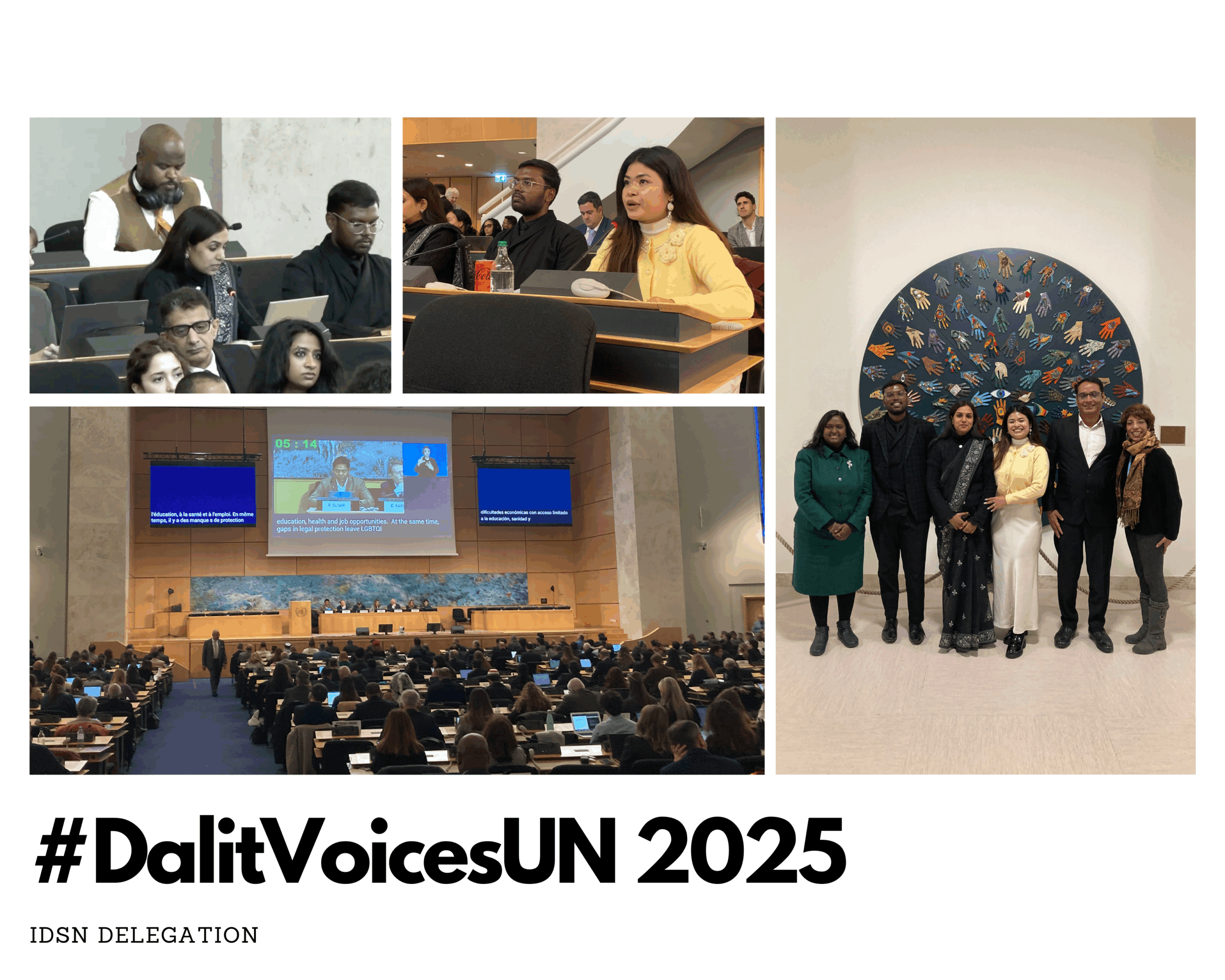 Addressing structural drivers of exclusion and mistrust
Rup Sunar, representing Dignity Initiative in Nepal, delivered a powerful intervention during the opening panel on Building Trust and Social Cohesion. He highlighted how minority communities, including Dalits, religious minorities and other marginalised groups, continue to face structural discrimination, social stigma, hate speech and legal and economic barriers that undermine peaceful coexistence.
Drawing on examples from South Asia and beyond, Rup stressed that trust and social cohesion can only be achieved when states address systemic inequalities, protect minority rights and ensure meaningful participation in decision-making. He called for stronger equity measures, better protection against hate crimes, inclusive education and platforms that amplify minority voices.
His remarks underscored the urgent need for long-term, community-led approaches that confront discrimination at its roots. Watch Rup’s video statement or download the written statement.
Calling for justice and protection for Dalit women in India
Manisha Rani, representing the All India Dalit Mahila Adhikar Manch (AIDMAM), spoke powerfully about the deep-rooted violence faced by Dalit women in India. She highlighted a dramatic rise in crimes against Dalit women over the past decade, noting the overwhelming majority of cases involving Dalit women remain pending in India’s courts.
She stressed that systemic discrimination, combined with low conviction rates and weak implementation of protective laws, continues to erode trust in institutions. Despite this, Dalit women remain leaders, peacebuilders and human rights defenders, playing a central role in strengthening accountability and rebuilding trust.
Her recommendations included strengthening the implementation of India’s Scheduled Castes and Scheduled Tribes (Prevention of Atrocities) Act, investing in Dalit women’s leadership and ensuring that the UN prioritises ending violence and discrimination against Dalit women as well as adopt global frameworks addressing discrimination based on work and descent. Watch Manisha’s video statement or read the written statement.
Raising concerns over shrinking civic space in India
Another IDSN delegate from India addressed the rapidly shrinking civic space for minorities and human rights defenders. The delegate highlighted increasing derogatory rhetoric targeting minorities, alongside discriminatory state actions including forced displacement of Adivasi communities, bulldozer demolitions disproportionately affecting Muslim communities and extrajudicial killings of Dalits.
Concerns were also raised that civil society organisations face reprisals for speaking out, while national institutions such as the National Human Rights Commission (NHRI) have been weakened. The speaker called on the Indian Government to strengthen the NHRI and engage fully with all UN human rights mechanisms, as well as to strengthen civic space to rebuild trust and safeguard democratic participation.
Spotlighting Dalit women workers’ leadership in global supply chains
Navamani Murthi, General Secretary of the Tamil Nadu Textile and Common Labour Union (TTCU), highlighted the critical yet undervalued contribution of Dalit women workers in the textile industry. She emphasised that meaningful change in global supply chains can only happen when the voices of workers, particularly women from marginalised caste backgrounds, are centred.
Drawing on her own experience as a former garment worker, she explained that grassroots unions like TTCU offer real-time, practical solutions that external monitoring systems cannot match. She urged global brands to engage directly with women-led worker organisations to ensure dignity, safety and fair working conditions in factories. Read the statement submitted to the Forum, the video will be uploaded to the Minority Forum pagesoon.
Promoting accountability and inclusion for Dalit women and girls in Nepal
Sarita Barmashakha, from the Feminist Dalit Organisation (FEDO) in Nepal, highlighted the persistence of caste discrimination despite constitutional guarantees of equality. She described intersecting barriers faced by Dalit women and girls in Nepal, including social segregation, discriminatory labour practices and limited access to justice.
Sarita also drew attention to positive examples of Dalit women’s leadership in Nepal, such as digital literacy initiatives and local level organising, which demonstrate the transformative impact of empowering Dalit communities. She called for strengthened enforcement of anti-discrimination laws, increased investment in Dalit women-led organisations and the integration of caste into global minority rights frameworks. Watch Sarita’s video statement or read the written statement
Highlighting intersectional discrimination: caste and disability
Krishna Gahatraj, the founder of the Dalit with Disabilities Association Nepal (DDAN), delivered an oral intervention focusing on the intersection of caste and disability. He highlighted how persons with disabilities from marginalised caste groups, especially women and girls, face uniquely layered discrimination that often goes unaddressed in policy frameworks.
He gave the example of Dalit women with disabilities facing exclusion from meaningful participation in politics and policy and the need to address this.
His intervention also called for disability and caste issues to be addressed intersectionally in both UN and national mechanisms including in disability legislation. He furthermore stressed the need for more inclusive policies, disaggregated data, better representation and accountability measures and ensuring meaningful participation at all levels. Watch Krishna’s video statement.
Recognising Dalit contributions in Bangladesh
Shagorika Das, from the organisation ‘DALIT’ in Bangladesh, submitted a statement highlighting the essential yet overlooked contributions of Dalit communities and the persistent segregation, stigma and discrimination they face. She stated that Dalits “clean our cities, craft leather goods, and keep society running. Yet they remain among the most excluded groups. Their homes are segregated, their children face stigma, and many struggle to access basic services and fair jobs.”
At the same time, she stressed that Dalit-led organisations are raising their voices, promoting education and demanding justice.
She called on the Government of Bangladesh to enact the Non-Discrimination Act, ensure stigma-free public services and expand opportunities for Dalit women and youth to participate fully and equally in society. Read the statement, the video will be uploaded to the Minority Forum page soon.
IDSN’s continued commitment to ensuring that Dalit voices are heard
IDSN’s participation in the 2025 UN Forum on Minority Issues was an inspiring mix of young, less experienced advocates and more seasoned campaigners. Their interventions and presentations continue to highlight the pressing need to combat caste discrimination globally and to promote the meaningful inclusion of Dalit communities in all areas of public life. The contributions of the Dalit activists who participated illustrate not only the scale of ongoing violations but also the resilience, leadership and expertise that marginalized caste groups bring to building peaceful and just societies.
IDSN reiterates the importance of ensuring that Dalit women, young activists, persons with disabilities and Dalit leaders are able to access global forums without barriers. Their direct participation is essential in shaping policies that reflect their lived experiences and advance their rights.
In addition to the interventions in the Forum sessions, the IDSN delegation also met with States and UN officials alongside the Universal Periodic Review pre-session of Nepal.